

Profitable but Always Broke: The Change Order Eating Your Cash
You can be profitable on paper and still sweat payroll. The usual culprit isn't sales. It's the change order nobody billed.
You can be profitable on paper and still sweat payroll. The usual culprit isn't sales. It's the change order nobody billed.
In construction, change orders are where margin is made or lost. The work gets done in the flow of the job, but the pricing, the approval, and the invoice often lag by weeks — or never happen at all. Every unbilled change order is cash you've already spent on labor and materials and revenue you haven't collected.
Stack that on top of slow billing and long payment cycles. The average general contractor now waits around 83 days to get paid, and subs wait longer — while crews get paid every two weeks and suppliers want their money in 30 days. That gap is the whole problem. It isn't profit. It's timing.
This is the messy middle in miniature: bigger business, bigger jobs, and a bigger gap between "spent" and "collected" than you've ever carried.
What to do: bill change orders the week they happen, not at the end of the job. Price and get sign-off before the work starts wherever you can. Watch days-to-collect like you watch your bank balance — because they're the same thing.
Profit is an opinion until the cash clears. Bill the change order while you still remember doing the work.

You Can Now Sell Farmland and Spread the Tax Over Four Years
If you sell farmland, the tax bill usually lands all in one year. A new rule lets some sellers spread it over four.
If you sell farmland, the tax bill usually lands all in one year. A new rule lets some sellers spread it over four.
The One Big Beautiful Bill Act created an election: when you sell farmland to a qualified farmer, you can pay the tax on the gain in four equal annual installments instead of all at once. For a family thinking about transition — selling to the next generation, a neighbor who farms, a young operator — that's a meaningful lever.
Why it matters: a land sale can throw one year's income into the top bracket, drag along other phaseouts, and turn a good sale into a brutal tax year. Spreading the gain over four years can keep you in lower brackets and smooth the hit.
This is general guidance, not a guarantee. Whether it fits depends on who the buyer is, how the deal is structured, and your whole picture that year. The definition of a "qualified farmer" and the mechanics matter — and they have to be set up correctly in the sale documents, not bolted on after closing.
What to do: if a land sale is anywhere on your horizon in the next few years, model it both ways before you sign anything. The structure has to be decided before the deal closes.
The worst time to learn about this election is April, after the sale. The best time is now, while the deal is still on paper.
2026 FARM PROGRAM UPDATE
Qualified Pass-Through Entities and Husband-Wife Farm Operations
Beginning with the 2026 program year, USDA/FSA will apply expanded payment-limit treatment to qualifying pass-through farm entities. The opportunity can be meaningful, but the result depends on genuine ownership, active engagement, AGI eligibility, attribution rules and timely FSA filings.
THREE POINTS TO KNOW
01 Expanded entity treatment
Partnerships, S corporations, qualifying LLCs and joint ventures may receive per-owner payment-limit treatment.
02 $164,000 ARC/PLC limit
The 2026 ARC/PLC cap is $164,000 per eligible person or legal entity, subject to program and attribution rules.
03 September 15 deadline
For program year 2026, affected entities should update their farm operating plans with the local FSA office by Sept. 15, 2026.
KEY DISTINCTION: QPTE is a USDA/FSA payment-limitation and eligibility concept - not a new federal income-tax entity classification.
What changed for 2026?
A broader group of pass-through farm entities can be treated more like general partnerships and joint ventures for payment-limit purposes.
A QUALIFIED PASS-THROUGH ENTITY INCLUDES
• A partnership, LP, LLP or LLLP within Subchapter K.
• An S corporation.
• An LLC that has not elected to be treated as a C corporation.
• A joint venture or general partnership.
Not included
A C corporation or an LLC that affirmatively elects C-corporation treatment is not a QPTE for this purpose.
FSA entity certifications should accurately identify whether the operation is a C corporation, S corporation, pass-through LLC or LLC taxed as a corporation.
Why the change matters
A QPTE may have a maximum payment capacity equal to the applicable program limit multiplied by the number of first-level eligible owners or non-QPTE legal entities.
PAYMENT-LIMIT FORMULA
PROGRAM LIMIT × ELIGIBLE FIRST-LEVEL OWNERS = POTENTIAL ENTITY CAP
A higher ceiling is not a guaranteed payment.
The USDA program must actually generate a payment. Each owner must also satisfy ownership, active-engagement, AGI and attribution requirements. Payments can be reduced for an owner who has already reached a limitation through another operation.
Illustration: two eligible owners
$164,000 × 2 = $328,000 potential ARC/PLC entity-level ceiling for 2026.
Payment limits and AGI eligibility
The expanded entity cap works together with direct attribution and owner-level income eligibility.
2026 ARC/PLC ILLUSTRATIONS
Eligible first-level owners
Calculation
Potential entity cap
1 $164,000 × 1 $164,000
2 $164,000 × 2 $328,000
4 $164,000 × 4 $656,000
AVERAGE AGI RULES
General rule
The $900,000 average adjusted gross income limitation remains relevant for many FSA and NRCS programs. The lookback generally uses three taxable years preceding the immediately preceding tax year.
QPTE owner-level certification
Beginning in 2026, a QPTE generally does not certify the $900,000 AGI limit at the entity level. Its individual members must satisfy the applicable AGI requirements.
75% farming-income exception
For specified conservation and disaster payments, the AGI cap may be waived when at least 75% of average gross income is from farming, ranching or silviculture and the required FSA certification is provided.
Broader farming-income definition
The 2026 rules recognize additional agriculture-related income, including agritourism, direct-to-consumer sales and certain sales or trades of agricultural equipment.
Married filing jointly: FSA generally assigns the joint-return AGI to each spouse unless an acceptable professional certification shows how income would have been reported separately, consistent with the joint return.
Advisor note
Review current versions of Forms CCC-941 and CCC-943 and the local FSA office’s documentation requirements before relying on an AGI exception.
Husband-wife farms: tax and USDA rules are different
A joint federal return does not, by itself, determine ownership or entity status for either system.MARRIED FILING JOINTLY DOES NOT AUTOMATICALLY CREATE A PARTNERSHIP, CREATE A DISREGARDED ENTITY OR COMBINE TWO SPOUSES INTO ONE USDA “PERSON.”
SIDE-BY-SIDE TREATMENT
Issue Federal income tax USDA/FSA program treatment
Joint return A filing status only. Each spouse remains a separate natural person for attribution.
Co-owned unincorporated farmGenerally a partnership unless a qualified joint venture election applies.
A genuine joint venture may be a QPTE.
QJV election
Avoids Form 1065; each spouse reports a share on separate Schedule F and Schedule SE.
Does not eliminate the underlying joint venture for FSA purposes.
Disregarded entity
Typically requires one owner, such as a single-member LLC.
Disregarded status is not required for QPTE treatment.
QUALIFIED JOINT VENTURE REQUIREMENTS
• The only members are spouses who file a joint return.
• Both spouses co-own the business and materially participate.
• Both elect not to be treated as a partnership.
• The business is not held in the name of a state-law entity such as an LLC or limited partnership.
• Income, deductions, gains, losses and credits are divided according to each spouse’s interest.
North Dakota note
North Dakota is not a community-property state. A North Dakota LLC owned by both spouses generally has two members, defaults to partnership tax treatment and cannot use the IRC section 761(f) QJV election while the business is held in the LLC.
Four common husband-wife farm scenarios
The classification depends on actual ownership and operating facts - not merely the tax return filing status.
SCENARIO A
Both spouses co-own and operate without an LLC
• Federal tax: Partnership by default; may elect qualified joint venture treatment if all requirements are met.
• USDA/FSA: Generally a husband-wife joint venture and QPTE if both are genuine owners/members.
SCENARIO B
One spouse owns; the other assists
• Federal tax: Generally a sole proprietorship. The assisting spouse may be an employee depending on the facts.
• USDA/FSA: Joint filing alone does not create a two-member operation; ordinarily only one ownership-based limit.
SCENARIO C
Both spouses own a North Dakota LLC
• Federal tax: Default partnership and Form 1065 unless a corporate election applies.
• USDA/FSA: QPTE if the LLC has not elected C-corporation treatment; an S corporation also qualifies.
SCENARIO D
One spouse owns a single-member LLC
• Federal tax: Generally disregarded unless a corporate election applies.
• USDA/FSA: The entity may be a QPTE, but multiplying by one owner does not increase the payment cap.
FACTS THAT SUPPORT A TWO-OWNER OPERATION
Ownership interest
Sharing profits and losses
Capital or property at risk
Labor or management
FSA operation records
Consistent legal and tax documents
Consistency matters
CCC-902E, crop-insurance shares, leases, FSA-578 acreage reports, bank accounts, production contracts, ownership records and federal tax reporting should tell the same story. FSA makes the final determination from the actual operating facts.
Active engagement: ownership alone is not enough
Each member supporting the expanded payment capacity must satisfy the applicable contribution and risk requirements.
Compensated contributions can count
Beginning in 2026, compensated active personal labor or management - including salary or guaranteed payments - may be used in meeting the actively engaged test for QPTE members, subject to the applicable rules and documentation.
CORE CONTRIBUTION FRAMEWORK
• A significant contribution of capital, equipment, land, active personal labor or active personal management.
• A share of profits and losses commensurate with the contribution.
• A contribution that is at risk.
• Labor or management that is regular, identifiable, documentable and separate from other members’ contributions.
SIGNIFICANT LABOR AND MANAGEMENT BENCHMARKS
ACTIVE PERSONAL LABOR
The smaller of 1,000 hours annually or 50% of the hours required for a comparable operation represented by the member’s share.
ACTIVE PERSONAL MANAGEMENT
At least 25% of total management hours or at least 500 hours annually.
These are general benchmarks. Family-member, landowner, cash-rent tenant and entity-specific rules can alter how the test applies.
SPECIAL RULES TO WATCH
Cash-rent tenant
When the tenant is a QPTE, each member - or the member’s spouse - generally must provide significant active personal labor or management for the member’s share of program payments on cash-rented land.
Land titled in the entity
A QPTE member may be treated as a landowner when the entity holds title and adequate documentation shows that title would revert to members upon dissolution.
2026 filing deadline and documentation
The expanded treatment is only useful when the farm operating plan, ownership records and supporting evidence are complete and consistent.
NOW: Review structure, ownership and crop-insurance/NAP timing.
BEFORE SEPT. 15: Prepare and update the entity farm operating plan.
SEPT. 15, 2026: Program-year deadline and ownership date for 2026 QPTE attribution.
AFTER 2026: FSA generally returns to June 1 for determining entity ownership interests.
FSA FILING AND RECORDS CHECKLIST
• File or update Form CCC-902E with the county FSA office that services the operation.
• Provide Form CCC-901 and separate CCC-902E filings for embedded entities when required.
• Gather articles, bylaws, operating agreements, partnership agreements and evidence of authority.
• Confirm ownership percentages, stock or membership ledgers and capital accounts.
• Retain leases, land titles, equipment records and proof of capital at risk.
• Maintain payroll, guaranteed-payment and labor/management time records.
• Reconcile FSA-578 acreage reports, crop-insurance shares, production contracts and bank records.
• Review CCC-941, CCC-943 and owner-level AGI support.
PRACTICAL FILING POINT
Where to file
CCC-902E is filed with the local USDA/FSA county office that maintains the farm’s records - not with the IRS or the state tax department. Work with the local FSA representative because supporting documents vary with the entity and ownership structure.
Coordinate before restructuring
Producers with crop insurance or NAP coverage should consult the crop-insurance agent or local FSA office before changing the farm structure so the timing does not unintentionally affect existing coverage or program records.
A practical action plan
Use the 2026 changes as a reason to align legal structure, tax reporting, FSA records and the way the farm actually operates.
Classify the operation
Determine whether the farm is a sole proprietorship, partnership, QJV, S corporation, pass-through LLC or non-QPTE corporation.
Confirm bona fide owners
Verify ownership, profit-and-loss sharing, contributions, risk and participation for every person expected to support a payment limit.
Test active engagement
Document labor, management, land, equipment and capital contributions using contemporaneous records.
Project limits and AGI
Model potential program caps, direct attribution, other farm interests and owner-level AGI eligibility.
Update and retain records
File the 2026 farm operating plan by the deadline and maintain consistent legal, tax, crop-insurance and FSA documentation.
OFFICIAL GUIDANCE AND ADDITIONAL READING
• USDA/FSA: USDA Expands Payment Limitation and Payment Eligibility Provisions for Farmers
• USDA/FSA: Payment Limitations
• USDA/FSA: Actively Engaged in Farming
• USDA/FSA: Adjusted Gross Income
• IRS: Married Couples in Business
• IRS: Election for Married Couples - Unincorporated Businesses
IMPORTANT NOTICE
This newsletter provides general information and is not legal, tax or program-eligibility advice. USDA/FSA determines eligibility from the applicable law, regulations, forms and operating facts. Consult the local FSA office, tax advisor and legal counsel before changing ownership or entity structure.

The Check Isn't the Deduction
Every December a farmer writes a big check to the co-op and figures he just bought himself a tax deduction. Sometimes he did, and sometimes that write-off slides into next year or gets thrown out, because the deduction was never really about the check. If a year-end move shifts real money on your operation, it's worth knowing the two gates that decide whether it actually counts.
Every December a farmer calls me feeling good about a check he just wrote to the co-op. Big number. Next year's seed, fertilizer, maybe a tank of fuel, all bought before the 31st. He's sure he just turned a tax bill into a deduction. Sometimes he did. Sometimes he bought himself a problem that doesn't surface until April.
Here's the part people get backwards. Yes, a cash basis farmer can deduct prepaid seed, feed, fertilizer, and chemicals in the year you pay for them, even though you won't put them in the ground until the next crop. But the write off does not come from the money leaving your account. It comes from two things the IRS actually looks at: whether you bought goods or just parked cash, and whether the prepaid amount stays under a line most operators have never heard of. Clear both and the strategy still works. Miss either and the deduction gets shoved into next year — or denied.
So writing the check isn't the work. Spending money is the easy part — hell, any operation can move cash out the door in December. The work is the structure around it. Two gates stand between you and the deduction.
Gate 1: You have to buy something, not park money
The IRS lets you deduct a prepayment for supplies only when three things are true at once. This isn't new and it isn't a gray area — it traces back to a 1979 ruling that's still how these get judged.
First, it has to be a real purchase, not a deposit. That's the one auditors lean on hardest. The invoice needs to nail down a specific quantity, a specific product, and a fixed price. A slip that says "Fertilizer — $30,000" is not a purchase. It's a coin flip you'll probably lose. And you can't reserve a right to a refund or to swap the money for something else later. The minute it looks like you could get your cash back, it's a deposit, and a deposit buys you no deduction.
Second, there has to be a business reason beyond the tax savings. This is easy to clear if you're honest about why farmers prepay in the first place: locking in a price before it climbs, or making sure the product is actually there when you need it in the spring. Those are real reasons. "My accountant said to spend money" is not.
Third, the deduction can't badly distort your income — pulling a giant expense forward in a way that has nothing to do with how you really operate. For most working farms that prepay every year as a matter of course, this isn't a problem. For the operation that's never prepaid a dime and suddenly dumps a year of income into December inputs, it can be.
Get those three right and you're through the first gate. Most of the time, that comes down to one thing: get a real invoice with real numbers on it, and don't let the co-op write it loose.
Gate 2: The 50% line
This is the gate that surprises people, because nobody mentions it until it costs them.
Your deduction for prepaid supplies you haven't used yet can't be more than half of your other deductible farm expenses for the year. Everything else on your Schedule F counts toward that other half — labor, rent, repairs, depreciation, the works — but the prepaid supplies themselves don't. Whatever you prepay above that 50% mark doesn't vanish. It just waits and deducts in the year you actually use it.
A number makes it concrete. Say your other deductible farm expenses for the year add up to $400,000. The most you can write off in prepaid supplies this year is half of that — $200,000. Prepay $300,000 of inputs in December and $100,000 of it does nothing for you this year. It carries to next year and deducts when the seed goes in the ground.
That's not the end of the world — you still get the deduction, just later. But if the whole point was to knock down this year's income, finding out in April that a third of your prepay slid into next year is a rough surprise.
There are two ways out of the 50% cap, and you only need one of them. They're open to a "farm-related taxpayer" — broadly, someone whose home is on the farm, whose main job is farming, or a family member of someone who fits. If that's you, you can deduct the full prepaid amount when either: the year ran over 50% because of an unusual, one-off change in how you operated; or your prepaids over the previous three years averaged under 50% of your other expenses. Steady operators who prepay normally most years tend to land inside that three-year history without trying. The farmer who goes big exactly once is the one who gets caught.
What this actually means before you write the check
None of this should scare you off prepaying. Done right, it's one of the oldest and cleanest tools a cash-basis farmer has for smoothing income between a fat year and a lean one. It just rewards the operator who sets it up on purpose instead of in a panic.
A few things to do and they're not complicated:
Get an invoice that states the quantity, the product, and the price. Make the co-op write it tight. "Seed and chem, $X" is the version that fails.
Don't sign anything that lets you claw the money back or trade it for something else. That language turns your purchase into a deposit.
Run the 50% math before you write the check, not after. Add up your other farm expenses for the year, take half, and know your ceiling. If you're going over, know which exception you're leaning on.
Have a reason you'd be comfortable saying out loud — locking price, securing supply. You almost certainly have one. Say it.
Talk to whoever does your return in November, not in March. The deduction is set by what you do before December 31. Once the year closes, there's nothing left to plan.
How the cap and the exceptions land depends on your specific operation and your numbers, so this is the general shape of the rules, not a verdict on your return. That's exactly the conversation worth having before year-end.
The bottom line
The check feels like the work. The check is the easy part.
The deduction lives in the invoice, the math, and the reason — and that's the part most people skip.
If you're running an operation big enough that a December decision moves real money, you shouldn't be guessing at it in the truck on the 30th. That's the kind of planning we do. Apply to work with us → https://steinkeandcompany.com/application
Give the Grain, Not the Check
Picture the check you write your church every year. You sold a load of grain to cover it, the money hit the account, and you wrote the check. It feels clean. It's also the most heavily taxed dollar you own — and starting this year, the tax law made that worse.
Here's the answer to the question most farm families never think to ask: if you raise grain and you give to a church or a food bank, you are almost always better off handing over the bushels than the cash. When you sell grain and donate the proceeds, that sale is ordinary farm income — hit with income tax, self-employment tax, and state tax before a dollar reaches the offering plate. When you give the unsold grain directly instead, that income is never reported at all. No income tax. No self-employment tax. No state tax. The church gets the same gift. Your tax bill is a lot smaller. And you still deduct what it cost you to raise the crop.
That's not a loophole. It's how the code treats a gift of something you grew but never sold. Let me lay it out, because the details are where people lose the benefit.
Why the check quietly fails most farm families
A cash gift to charity is only worth something on your taxes if you itemize. Most farm families don't. With the 2026 standard deduction at $32,200 for a married couple, even fewer will. If you take the standard deduction, your cash gift to the church does almost nothing for your federal taxes — you'd have written that check anyway, and the tax code shrugs.
It gets a little worse this year. The One Big Beautiful Bill Act added a new floor: starting in 2026, even farmers who do itemize can only deduct charitable gifts above 0.5% of their income. On $300,000 of income, the first $1,500 you give doesn't count. Congress also created a small consolation for non-itemizers — you can now deduct up to $2,000 of cash gifts as a married couple without itemizing. That's real, but it's a thin slice of what's actually on the table.
Every one of those rules applies to deductions. And here's the part that matters: when you give grain, you're not taking a deduction at all. You're keeping income off the return in the first place. None of the new limits touch it.
Why the grain works differently
When you donate a raised commodity you haven't sold, the IRS doesn't treat it as income you gave away. It treats it as a gift of property you owned. You never recognized the sale, so there's no income to tax — not for income tax, not for self-employment tax, not for the state. On top of that, you still get to deduct the cost of raising that grain as a normal farm expense. You don't lose the seed, fertilizer, and fuel deductions just because you gave the crop away.
So the grain route skips the whole tax stack that the check route walks straight into. That's why the bushels are worth more to your church than the check — same gift to them, far less cost to you.
What the numbers look like
A rough, illustrative example — your own numbers will be different, so treat this as the shape of it, not a projection for your return.
Say you give $10,000 to your church each year, and you take the standard deduction like most farm families.
Write the check: first you sell $10,000 of grain. As a sole-proprietor farmer that's ordinary income, so between federal income tax, self-employment tax, and state tax you can easily lose $3,500 to $4,000 of it before you ever write the check. Because you take the standard deduction, the gift itself claws back only the new $2,000 non-itemizer deduction — worth a few hundred dollars. You gave $10,000 and the tax cost of getting there ran into the thousands.
Give the grain: you deliver $10,000 of grain to the church before any sale. Nothing about that sale lands on your return — no income tax, no self-employment tax, no state tax on it — and you still deduct what it cost you to grow it. The church sells the bushels and gets the full value.
Same $10,000 in the plate. One route costs you thousands in tax to pull off. The other costs you the grain and nothing more. Do that every year and the gap compounds.
The rules you can't fumble
This works only if the gift is done right. Get it wrong and the IRS treats it as if you sold the grain and donated cash — and you owe the tax you were trying to skip.
The grain has to move before it's sold. You cannot sell it and then donate the money. Title has to pass to the charity first.
Give up control. Once it's the charity's grain, the charity decides when and at what price to sell. You don't get to direct the sale. At the elevator, the bushels go into the charity's name and the sale invoice lists the charity as the seller. For grain stored on your own farm, document the transfer with a notarized letter or bill of sale before anything moves.
No buying it back. Don't have the charity turn around and sell the grain back to you — that round-trip is exactly what gets unwound on audit. If you need the grain, buy it from someone else and let the charity sell to an independent buyer.
Handle your FSA certification first. Get any Farm Service Agency bushel certification done in your name before the grain changes hands, so you don't muddy your production history.
These aren't hard. They're just specific, and the order matters.
If you grow produce, there's a second door
If you raise vegetables, fruit, eggs, or dairy rather than grain, there's a separate rule worth knowing. Donate wholesome food to a charity that feeds the hungry, ill, or infants, and you can claim a deduction equal to half the fair market value even when your tax basis in the crop is zero. It's an itemized deduction, so the new 0.5% floor applies and it's capped at 15% of your net farm income — but for a grower donating real quantity, that's usually a minor speed bump, not a wall. You'll want a written statement from the charity confirming how the food was used. Whether it beats simply gifting the unsold commodity depends on your operation, so it's worth running both.
One caution if you're the landlord, not the farmer
This is for the person who grew the crop. If you rent your ground out and take a share of the crop as rent, those bushels are rental income to you the moment you're entitled to them, and gifting them doesn't erase that income the way it does for an active farmer. The strategy is built for working farmers giving crops they raised — not for crop-share landlords. If that's your situation, the answer isn't "never," it's "talk it through first," because the tax treatment is genuinely different.
What to do now
If you give to a church, a food bank, or any charity every year and you raise grain or livestock, the move is simple to set up and worth a short conversation before your next load goes to town. Instead of selling and writing a check, can you transfer the bushels directly? For most cash-method farmers the answer is yes.
How this lands depends on your income, your state, and how your operation is structured, so this is the general shape of the rules, not advice on your specific return. That's the conversation to have before the crop is sold, not after.
The bottom line
The check feels like the generous thing. It's the expensive thing.
Give the bushels. Same gift to the church, a fraction of the cost to you — and the new law only widened the gap.
If you're giving every year and still funding it the most expensive way, that's the kind of thing a real plan catches. Apply to work with us → https://steinkeandcompany.com/application*

Farm Meal Deductions Changing in 2026: What Producers Should Know
Beginning in 2026, farm operations will no longer be able to deduct meals provided to employees during busy seasons like planting and harvest. Here’s how the rule is changing.
Providing meals to employees during busy times like planting and harvest has long been part of farm operations. For many farms, it’s simply part of keeping crews working efficiently during long days in the field.
However, tax rules surrounding these meals have changed over the past several years—and another change is scheduled to take effect in 2026.
How the Tax Cuts and Jobs Act Changed Meal Deductions
When the Tax Cuts and Jobs Act (TCJA) was passed at the end of 2017, it made several changes to how meal expenses could be deducted for tax purposes.
Before this law, many farmers were able to deduct 100% of meals provided to employees, particularly when those meals were provided on-site for the convenience of the employer during busy seasons like planting or harvest.
The TCJA changed that rule.
Beginning January 1, 2018, meals provided to employees including meals connected with harvest crews, planting crews, or farm labor generally became only 50% deductible.
This change also applied in situations where farmers were providing both lodging and meals for employees, and in some cases even applied to meals provided to the farm operator.
Another Change Coming in 2026
The TCJA provision was temporary.
Under the current law, the deduction for these meals is scheduled to expire after December 31, 2025.
Beginning January 1, 2026, meals provided to employees in these situations will no longer be deductible at all.
Farmers will still be able to provide meals to employees during harvest, planting, or other busy times if they choose to do so. The difference is that those costs will no longer reduce taxable income.
Could Congress Change the Rule?
Tax law often evolves, and it’s possible that Congress could revisit this provision before the end of the year.
Lawmakers could choose to:
Restore a partial deduction, or
Reinstate the full deduction that existed prior to 2018.
However, until any changes are passed, the current law indicates that these meals will become non-deductible starting in 2026.
Planning Ahead
For many farms, the cost of providing meals during busy seasons may not be significant enough to change operations. But it’s still important to understand how the tax treatment of these expenses is changing.
As we move closer to 2026, farmers may want to review how these costs are recorded and how they impact overall tax planning.
Staying informed about upcoming tax law changes can help farm operations avoid surprises and make better financial decisions.
Steinke & Company

Major Tax Changes Could Be Coming in 2026: What Small Business Owners Should Know
Key tax provisions for small businesses including the 20% QBI deduction are scheduled to expire after 2025. Learn what North Dakota business owners should watch as 2026 approaches.
Several major tax provisions that have benefited small business owners for the past several years are scheduled to expire after December 31, 2025.
These provisions were originally created under the Tax Cuts and Jobs Act (TCJA) and have played a significant role in reducing taxes for many businesses across the country—including here in North Dakota.
Unless Congress takes action to extend or modify them, 2026 could bring meaningful tax changes for business owners.
The 20% Qualified Business Income Deduction
One of the biggest provisions set to expire is the Qualified Business Income (QBI) deduction, often called the Section 199A deduction.
This deduction allows many owners of pass-through businesses such as:
LLCs
Partnerships
S-Corporations
Sole proprietorships
to deduct up to 20% of their qualified business income.
For many small businesses, this deduction has significantly reduced their overall tax burden.
If the provision expires, business owners could see higher taxable income starting in 2026.
Individual Tax Rates May Increase
The TCJA also temporarily reduced individual tax rates across several brackets.
If these provisions sunset as scheduled, tax rates could revert to pre-2018 levels, which means some business owners may see higher personal tax rates on business income.
Because most small businesses are pass-through entities, these individual rate changes can have a direct impact on business owners.
Estate and Gift Tax Exemption Could Drop
Another major provision scheduled to change is the federal estate tax exemption.
Currently, individuals can pass on over $13 million without triggering federal estate tax. In 2026, that exemption could be reduced roughly in half if the law sunsets.
While this primarily affects larger estates, it could have implications for:
Multi-generational farms
Family-owned businesses
Land transfers
Why Planning Now Matters
Although 2026 may seem far away, tax planning often works best when decisions are made years in advance.
Business owners may want to start thinking about:
Income timing strategies
Equipment purchases and depreciation planning
Business structure reviews
Long-term succession planning
The actual outcome will ultimately depend on what Congress decides, but preparing early can help avoid surprises later.
Staying Ahead of the Changes
Tax laws change regularly, and the next few years could bring significant updates for small business owners.
Keeping an eye on upcoming tax changes and planning ahead can help businesses stay flexible and make informed financial decisions.
For North Dakota business owners, working with an advisor who understands both tax law and local industries can make a big difference when navigating these changes.
Steinke & Company

What Farmers Should Know About 1099 Reporting in 2026
1099 reporting is a common headache for farm operations. Here’s what North Dakota farmers need to know about issuing 1099s to contractors and avoiding IRS penalties.
If you run a farm or ag business, tax paperwork is nothing new. But every year we still see producers run into the same surprise when January rolls around: 1099 reporting requirements.
Whether you hire custom operators, truckers, agronomists, or independent contractors, there’s a good chance some of those payments require a Form 1099-NEC.
And if those forms aren’t issued correctly, the IRS can apply penalties that add up quickly.
When Farmers Must Issue a 1099
Most farm operations must issue a 1099-NEC when they pay $600 or more to a non-employee for services during the year.
Common examples in agriculture include:
Custom combining or spraying
Independent truck drivers hauling grain or livestock
Agronomy or consulting services
Equipment repair by independent contractors
These payments must be reported if the provider is operating as an individual, partnership, or LLC taxed as a partnership.
When You Typically Don’t Need One
There are a few situations where a 1099 usually isn’t required.
You generally do not issue a 1099 if:
The vendor is taxed as an S-Corporation or C-Corporation
The payment was made by credit card or payment processor
The expense was for products rather than services
However, the safest approach is to collect a Form W-9 before paying any new vendor so you know their tax classification.
Why the W-9 Matters
The W-9 tells you:
The vendor’s legal name
Their business entity type
Their taxpayer identification number
Without this information, preparing 1099s in January becomes much harder and sometimes impossible.
Many farmers don’t think about this until the end of the year, when trying to track down contractors who finished work months earlier.
Penalties Are Increasing
The IRS continues to increase penalties for missing or incorrect 1099 forms.
Penalties can range from $60 to $310 per form, depending on how late the correction is made. For farms working with multiple custom operators or service providers, that can add up quickly.
A Simple Habit That Saves Time
The easiest way to avoid 1099 headaches is simple:
Request a W-9 before the first payment is made.
Keeping those forms on file throughout the year makes January reporting much easier and prevents last-minute scrambling.
Planning Ahead
Agriculture businesses often work with a wide range of contractors throughout the season. Taking a few minutes to organize vendor information now can save significant time and stress at tax time.
If you have questions about 1099 requirements, farm tax planning, or ag business structures, working with an accountant who understands agriculture can make a big difference.
Steinke & Company

What Might 2026 PLC Payments Look Like?
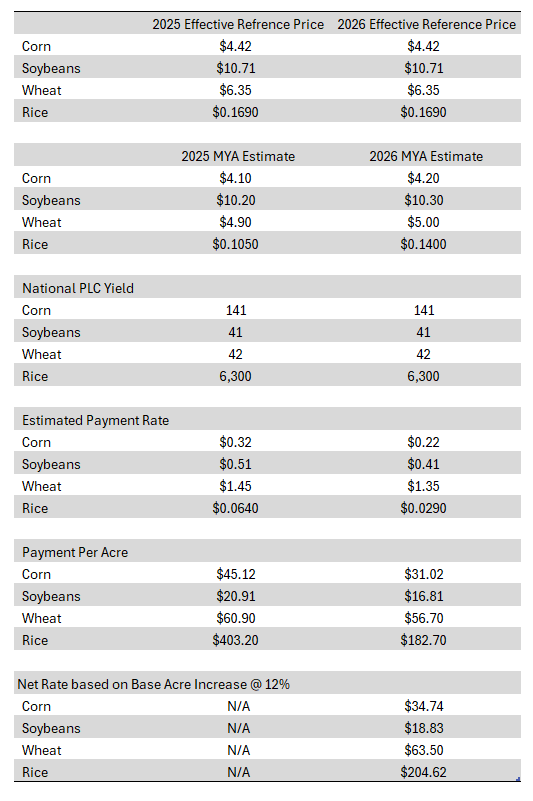
What could 2026 PLC payments look like? Using USDA Ag Outlook Forum projections, we estimated potential national PLC payment rates for corn, soybeans, wheat, and rice — and early numbers suggest lower rates compared to 2025, with base acre increases partially offsetting the decline. Here’s what that could mean for producers.
Let’s talk farm policy.
We know. Not exactly edge of your seat material. But when it impacts your operation’s cash flow, it gets a lot more interesting.
Last week, USDA released updated projections at the Ag Outlook Forum, including estimated 2026 national MYA (Marketing Year Average) prices for corn, soybeans, and wheat. Those projected MYA prices are what drive potential PLC (Price Loss Coverage) payments.
So we ran some early numbers.
How We Built the Estimate
Using USDA’s projected MYA prices, we calculated preliminary 2026 national PLC payment rates for:
Corn
Soybeans
Wheat
Rice
For rice, we used a 14-cent per hundredweight MYA estimate. As additional MYA projections are released, we’ll continue refining these estimates.
Keep in mind — this is early. These are projections built on price outlooks before most 2026 crops are even in the ground.
What the Numbers Suggest
Based on current USDA projections:
All major crops show a decrease in PLC payment rates compared to 2025.
However, base acres nationally are expected to increase by roughly 12%.
After accounting for that increase in base acres, wheat shows a slight overall increase in total payments compared to 2025.
In other words: payment rates may be lower, but expanded base acres could partially offset the decline.
Important Notes
A few things these numbers do not reflect:
Payments are only made on 85% of base acres (the standard PLC reduction).
Payment limitations are not factored into these estimates.
Actual 2026 MYA prices could change significantly.
And perhaps most importantly — we are very early in the cycle. Final projections will shift as planting decisions, weather, global production, and markets evolve.
What This Means for Producers
Right now, this isn’t about making final decisions. It’s about staying aware.
Lower projected PLC rates may mean:
Tighter safety net support in certain crops
Greater sensitivity to market price swings
More importance placed on crop insurance and marketing strategy
The 12% base acre increase helps, but it may not fully offset declining payment rates depending on how prices develop.
We’ll continue monitoring updates and adjusting projections as new data becomes available.
Because farm policy may be dry — but its impact on your operation isn’t.
If you have questions about how PLC projections affect your farm’s cash flow planning, reach out. We’re watching it closely.
Steinke & Company

Front Office Receptionist (In-Person)
Steinke & Company is seeking a highly organized, tech-savvy Front Office Receptionist & Operations Associate to serve as the face and operational backbone of our Rugby, ND tax and accounting office. This is a fast-paced, client-focused role ideal for someone who thrives on multitasking, follows through without supervision, and takes pride in keeping systems, schedules, and client communication running smoothly.
About the Role:
Steinke & Company is a tax and accounting firm serving agricultural producers and rural small business owners. We are looking for a highly capable Front Office Receptionist & Operations Associate to serve as the face and backbone of our office.
This is not a passive front desk role. This position requires strong customer service skills, solid technology fluency, exceptional memory, and self-directed follow-through. You must be comfortable multitasking in a fast-paced office, managing multiple systems at once, and keeping things moving without constant supervision.
If you thrive in organized chaos, enjoy helping people, and naturally take ownership of tasks until they are complete, this role may be a strong fit.
Schedule Requirements:
May – November: (Off Season)
Monday – Thursday, 9:00am–3:00pm (Central)
December – April (Tax Season): Monday – Friday, 9:00 am–4:00 pm (Central)
Additional hours may be required during peak tax season.
Key Responsibilities:
Front Office & Client Service
Greet clients professionally and warmly in person and by phone
Answer and manage a multi-line phone system
Transfer calls appropriately, take detailed messages, and ensure follow-through
Schedule appointments and manage calendars
Be the first point of contact during tax season
Help clients log into and navigate our secure client portal
Send and track client organizers and tax return deliveries
Maintain professionalism during high-stress client interactions
You must have excellent memory and follow-up habits. If someone calls, emails, or drops something off, it must be handled or tracked until resolved.
Administrative & Office Support:
File management and document organization (Google Drive & internal systems)
Maintain client records accurately
Manage calendars (Acuity & Google Calendar)
Provide general administrative support to the CEO and remote team
Assist with 1099 entry and other seasonal data entry
Support monthly bookkeeping clients (QuickBooks Online)
You must be able to juggle multiple active tasks without dropping details.
Operations & Systems Support:
Use and help maintain our CRM and workflow systems (Canopy)
Help design and implement simple automations
Keep internal processes organized and updated
Assist with onboarding and offboarding clients
Maintain standard operating procedures and templates
You should be comfortable learning new software and troubleshooting basic issues independently before asking for help.
Required Skills & Qualities:
Strong customer service and interpersonal skills
Confident, clear communicator (phone and in person)
Comfortable with technology and cloud-based systems
Excellent attention to detail
Strong memory and task follow-through
Self-directed and able to work independently
Comfortable working in a busy office with multiple interruptions
Able to prioritize and shift quickly between tasks
Professional, calm, and reliable under pressure
Ability to keep privacy and confidentiality for our clients
Preferred (Not Required):
Experience in a tax, accounting, legal, or medical office
Familiarity with QuickBooks Online
Familiarity with client portals or CRM systems
Experience during tax season or other seasonal business cycles
This Role Is NOT For You If…
You need constant instruction or supervision
You avoid phone communication
You struggle with technology
You dislike multitasking
You have difficulty following through on details
You prefer slow, repetitive admin work
You hate people
Why Join Us?
We serve hardworking rural business owners and agricultural producers. Our team values professionalism, initiative, and continuous improvement. We are building systems that support both our staff and our clients.
If you enjoy being the organized center of a fast-moving office and take pride in keeping things running smoothly, we’d love to hear from you.
How to Apply
Send a short introduction explaining:
Your previous administrative or office experience
What software tools you’ve used
How you stay organized when things get busy
An example of a time you had to manage multiple tasks at once
Bonus: Include a short Loom video explaining how you manage tasks or handle difficult client situations.
Job Types: Part-time, Full-time
Benefits:
401(k)
401(k) matching
Dental insurance
Employee discount
Health insurance
Paid time off
Professional development assistance
Retirement plan
Vision insurance
Schedule:
Day shift
Monday to Friday
No nights
No weekends
Supplemental Pay:
Bonus pay
Experience:
Customer service: 4 years (Required)
Ability to Commute:
Rugby, ND 58368 (Required)
Work Location: In person